AN INTERACTIVE FIELD STUDY · 01
A question,
two bones.
What can a shape ask us to notice? Explore chicken-bone divination through a model you can turn, a question you can hold, and manuscripts you can open.
A contemporary interpretation, grounded in historical accounts and published Buyi research.
3D is unavailable on this browser. The arrangement diagram and all readings remain available below.
Move to turn · Click to pause / resume · Touch: drag · Keyboard: arrows, Space to pause
01 / AN AFFAIR, OR JUST A LOOK
What is on
your mind?
Journeys, illness and disputes, house-building: affairs associated with divination. The last two prompts are invitations for visitors today. [2, p. 116]
Add your words · optional · any languageChoose an affair or hold a question of your own. The form is drawn at random; read the accompanying reflection in its light. Your words stay in this page.
Direction. Distance. Relation.
Look at what changes between the bones.
BEYOND THE MODELAn object within a ritual.Open the illustrated guide · bone, sequence, people and books+
Chicken-bone divination brings an everyday concern into a ceremonial setting. A pair of bones, bamboo pegs, spoken invocations and an illustrated book can each have a part. These scenes follow two documented accounts: Zhou Qufei’s twelfth-century description and a modern study of Buyi practice.
- 01
Bring an affair into the ritual
Zhou’s account begins with incense and a prayer naming the matter. The modern Buyi collection places divination within sacrificial practice and records invocations in some books. [1; 2, pp. 112–113]
- 02
From an offering to paired bones
In Chen Mingmei’s description, a sacrificial rooster is cooked, the flesh removed, and its paired thigh bones examined. The diagram shows where these bones belong. [2, p. 113]
- 03
Make the small openings visible
Fine bamboo pegs are placed in small openings. Their slant, direction and relation become visible signs to inspect together. [1; 2, p. 113]
- 04
Read with a book and a practitioner
The Buyi study describes comparison with illustrated books. Ritual specialists interpret the forms within the ceremony and the matter at hand. [2, pp. 113–115]
WHICH BONE?
The upper leg, within the body’s outline.
The femur joins hip and knee. It is higher than the exposed lower leg we usually notice on a standing chicken. Chen Mingmei identifies the paired thigh bones; Zhou uses the broader term “leg bones.”
The site’s object simplifies the bones and the pegs so that you can turn them and compare arrangements. It does not reproduce a particular community’s ceremony.
Read these scenes as a comparison of accounts, not a single rule for all communities. Left/right conventions and interpretations differ. Full references [1–3] appear in the reading room below.
A TABLE OF FORMS
Look across the forms.
Begin with these eight pairs. Open any diagram to turn the model and read its verse.
Simplified study diagrams and newly written verse; the source traditions are discussed below.
Find a particular pair
Choose each side, then open the matching form and reading. No question is needed.
FROM MY COLLECTION
The marks on the page.
Compare the model with paired diagrams in two manuscripts. Look at the drawings, their placement and the surrounding handwritten text.
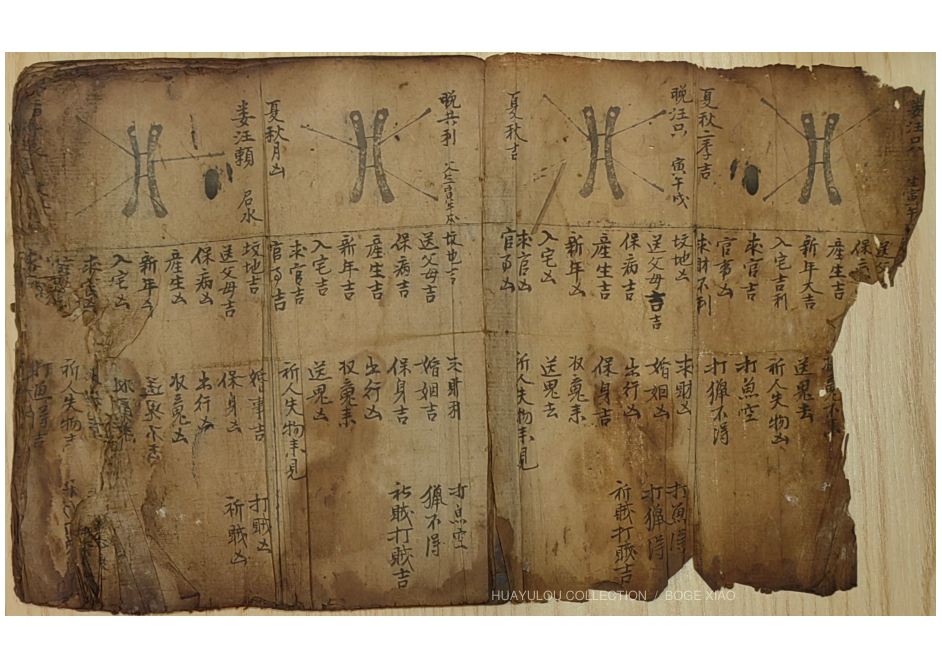
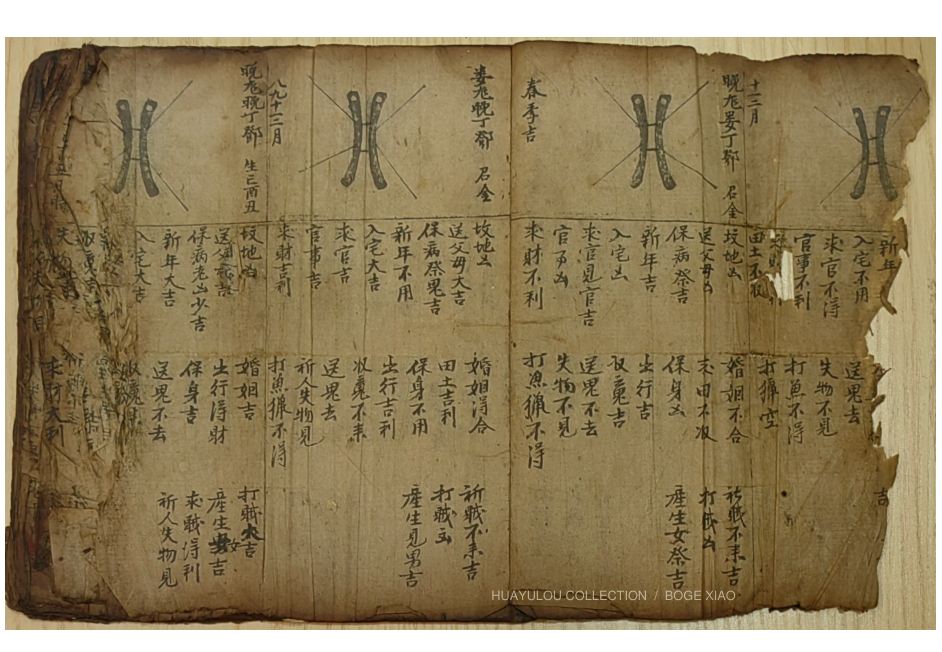
Three more volumes to browse
THE READING ROOM
A model, with its sources open.
What the records tell us
In the twelfth century, Zhou Qufei described bamboo slivers inserted into holes in a pair of chicken leg bones. He mentioned eighteen variations and broadly associated straight, upright or close-fitting pegs with favorable readings. He did not list eighteen complete configurations. [1]
The 2011 Buyi study records 190 individual diagrams in four birth-year groups. Paired positions, names and readings vary across accounts; diagrams belong to a larger ritual practice and are not a universal code. [2, 3]
What this interface adds
Eight simplified form families guide the model. Within them, peg angles, lengths and depth vary continuously. These variations, equal random chances, verdict rules and reflective readings are website designs, not a numbered traditional canon. The model does not reconstruct the eighteen variations in Zhou’s account.
Left/self and right/affair follow Zhou’s description. The book includes a different left/right convention. The 3D object is an illustrative model, not a scan of a ritual specimen. All verses are newly written for the site. This is an invitation to observe and reflect, rather than a prediction of events.
See the combination rule
Unpegged on either side: unsettled. Otherwise, a downturned side, two outward sides or two crossed sides: unfavorable. The remaining forms receive weights: close/upright/parallel +2, inward +1, outward/crossed −1; totals of 2 or more are favorable, and the rest unsettled. These weights are a design device.
- Zhou Qufei · Lingwai daida, vol. 10, “Chicken divination”
Historical account; the source for the left/self convention and the broad straight/close-to-bone principle.
- Chen Mingmei, Xiao Xi, Qiu Jing, Zhu Meng, Liu Li & Chen Wenlin. 2011. Chicken-bone divination: a study of Buyi sacrificial culture. Beijing: Writers Publishing House.
ISBN 978-7-5063-3324-5. Explanatory notes, pp. 3–5; Chen Mingmei on collection and analysis, pp. 112–115; Liu Li on historical accounts, pp. 116–126. The photographs and diagrams inform the model; the book’s PDF is not reproduced here.
- Yang Qingmei. 2013. “Culture, History and the Ethos of Nation”: Tao Yunkui and the German Elements in Chinese Anthropology. Society, 33(2): 53–83.
Discusses Tao’s comparative work on chicken-bone divination, including variation in numbers of signs and host/guest positions.
Concept & collection: Boge Xiao · Digital interpretation, 2026